Bookkeeping is not optional. Every UK business needs accurate financial records for tax compliance, VAT returns, and basic decision-making. But for small businesses operating on tight margins, bookkeeping costs can feel disproportionate to the value they appear to deliver.
The typical UK small business pays between £150 and £350 per month for standard bookkeeping services, according to 2025-2026 market data from Bark, DigiAccounting, and BefreeLtd. Full-service packages that include VAT, payroll, and management reporting can push that figure to £300 to £900+ per month. For a business turning over £100,000 a year, bookkeeping alone can represent 2% to 4% of total revenue.
The question most business owners ask is: how do I reduce this cost? The more useful question is: where is the money actually going, and which parts of the process are consuming more than they should?
This guide breaks down where bookkeeping costs come from, identifies the specific areas where most businesses overspend, and outlines practical steps to reduce costs without compromising accuracy or compliance.
What Bookkeeping Actually Costs in the UK?
Before reducing costs, it helps to understand the current market. UK bookkeeping rates vary by region, complexity, and service level.
Hourly rates range from £20 to £55 per hour, with the median sitting around £33 according to the 6 Figure Bookkeeper Pricing Report. Monthly packages range from £80 for basic transaction recording to £900+ for full-service support including VAT returns, CIS, payroll, and management accounts.
London rates sit at the higher end. Regional firms are typically 20% to 30% cheaper, though the quality of work varies more than the geography might suggest.
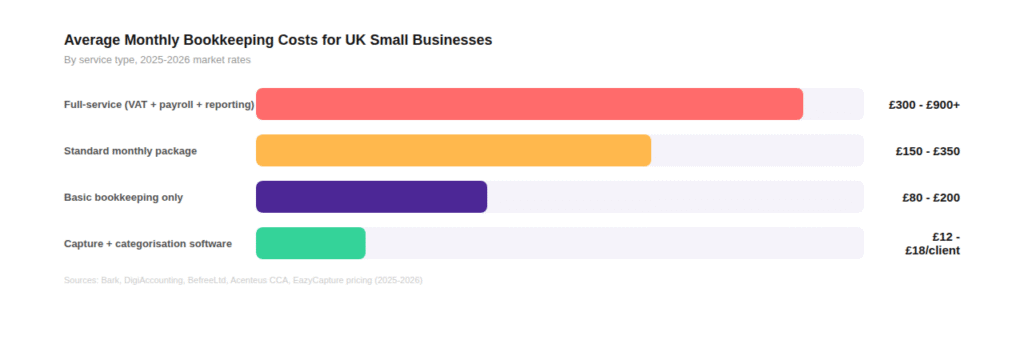
The bottom bar on this chart is worth noting. Capture and categorisation software (the layer that handles invoice extraction, VAT assignment, and posting to the ledger) costs between £12 and £18 per client per month. That is a fraction of the cost of the manual labour it replaces.
Where Bookkeeping Hours Actually Go?
The reason bookkeeping costs are high is not that accountants and bookkeepers charge too much. It is that a large portion of the work they perform is low-value processing that should not require human attention.
Research from the AICPA, the GBTA Foundation, and UK bookkeeper surveys consistently shows the same pattern.
Roughly 75% of bookkeeping time goes to tasks that are either fully automatable or significantly reducible through better tools: data entry, receipt chasing, corrections, and reconciliation. Only about 10% of time goes to the high-value work that actually helps a business make better financial decisions.
This is the core insight. Most businesses are not overpaying for bookkeeping. They are paying a fair rate for a process that is fundamentally inefficient. The cost reduction opportunity is not in negotiating a lower hourly rate. It is in eliminating the hours that should not exist.
“Most businesses are not overpaying for bookkeeping. They are paying a fair rate for a process that is fundamentally inefficient.”
7 Practical Ways to Reduce Bookkeeping Costs
The following strategies are ordered by impact, starting with the changes that typically produce the largest cost reduction.
1. Automate invoice capture and categorisation.
This is the single highest-impact change a small business can make. Automated invoice processing eliminates the manual data entry step entirely. Instead of a bookkeeper keying in supplier, date, amount, and VAT code from each invoice, the software extracts the data in seconds, maps it to the chart of accounts, and posts it to Xero or QuickBooks with the original document attached.
Industry benchmarks show that automation reduces processing costs by up to 80% per invoice (from 2.88 manual to .36 automated, per APQC and Ascend Software data). For a business processing 200 invoices per month, that translates to significant savings in bookkeeper hours.
2. Stop chasing receipts manually.
Receipt collection is one of the biggest hidden time costs in bookkeeping. The GBTA Foundation found that 55% of firms cite receipt attachment as a major pain point, and 19% of expense reports contain errors caused in part by missing or incorrect documentation.
The fix is structural, not behavioural. Instead of asking business owners to keep receipts and submit them monthly, use a system where receipts are captured at the point of transaction. Photograph it, email it, or upload it the day it arrives. The longer a receipt sits in a pocket or a drawer, the more it costs to process later.
3. Reduce the correction loop.
Manual data entry produces error rates between 1% and 4%, according to peer-reviewed research. Each error triggers a correction cycle: identify the mismatch, find the original document, verify the correct figure, update the ledger, re-reconcile. The GBTA Foundation puts the average correction cost at 2 per erroneous report.
Reducing errors at the point of entry (through automation) eliminates the downstream correction cost. This is not about working more carefully. It is about removing the manual step where errors are introduced.
4. Use cloud accounting software properly.
94% of UK accountants use cloud accounting systems, but many businesses underutilise them. Features like automated bank feeds, rule-based categorisation, and recurring transaction templates can handle a significant portion of routine bookkeeping without human intervention.
If the business uses Xero or QuickBooks but still emails PDFs to the bookkeeper for manual entry, the cloud subscription is being wasted. The value of cloud accounting comes from connecting it to an automated capture layer that feeds clean data directly into the system.
5. Match the service level to the actual need.
Not every business needs full-service bookkeeping. A sole trader with 50 transactions per month does not need the same package as a limited company with payroll, CIS, and multi-currency invoicing. Many businesses are on plans that include services they do not use.
Before renewing a bookkeeping contract, audit what services are actually being delivered each month. If payroll is included but the business has no employees, or if management accounts are produced but never reviewed, the package is too large.
6. Bring the easy work in-house (and outsource the hard work).
Bookkeeping is not a single task. It is a collection of tasks with very different skill requirements. Data entry and receipt categorisation require minimal expertise. VAT returns, year-end accounts, and tax planning require significant expertise.
The most cost-effective model for many small businesses is to handle the routine capture and categorisation in-house using software, and outsource only the compliance and advisory work to a qualified bookkeeper or accountant. This reduces the volume of work the external provider handles (and therefore the cost) while keeping the high-stakes work in expert hands.
7. Process in real time, not in batches.
Batch processing (saving everything for month-end) is more expensive than real-time processing. When documents pile up, the bookkeeper spends more time sorting, matching, and correcting than they would if transactions were recorded as they occurred. Memory degrades. Duplicates multiply. Error rates increase.
Processing invoices and receipts as they arrive, rather than in a monthly batch, reduces the total bookkeeping time per transaction. Tools that support real-time capture from email, mobile, or bulk upload make this practical for businesses that previously defaulted to the shoebox approach.
How Much Can You Realistically Save?
The savings depend on the business’s current setup and transaction volume. But the maths is straightforward.
A business currently paying £300 per month for bookkeeping, with the majority of that cost going to data entry and receipt processing, could reduce the workload by 50% to 70% through automation and real-time capture. If the bookkeeper’s fee adjusts accordingly (or if the business switches to a lower-tier package and handles capture in-house), the saving is £100 to £200 per month, or £1,200 to £2,400 per year.
For larger businesses processing higher volumes, the savings scale proportionally. A firm processing 500 invoices per month that moves from fully manual entry to automated capture can recover dozens of bookkeeping hours per month.
The goal is not to eliminate bookkeeping spend entirely. It is to redirect the spend away from manual processing and toward the work that actually matters: accurate compliance, clean records, and financial insight that helps the business grow.
The Bottom Line
Bookkeeping costs in the UK are rising because compliance requirements are increasing, labour costs are climbing, and the demand for digital record-keeping under MTD is adding new obligations. These are structural trends that are unlikely to reverse.
But the cost of the manual work within bookkeeping is entirely within the business owner’s control. Every invoice keyed by hand, every receipt chased by email, every correction cycle triggered by a data entry error is a cost that can be reduced or eliminated through better tools and better processes.
The businesses spending the least on bookkeeping in 2026 are not the ones that found the cheapest provider. They are the ones who removed the cheapest work from the provider’s scope entirely.
Start automating invoice capture with a 14-day free trial of EazyCapture.