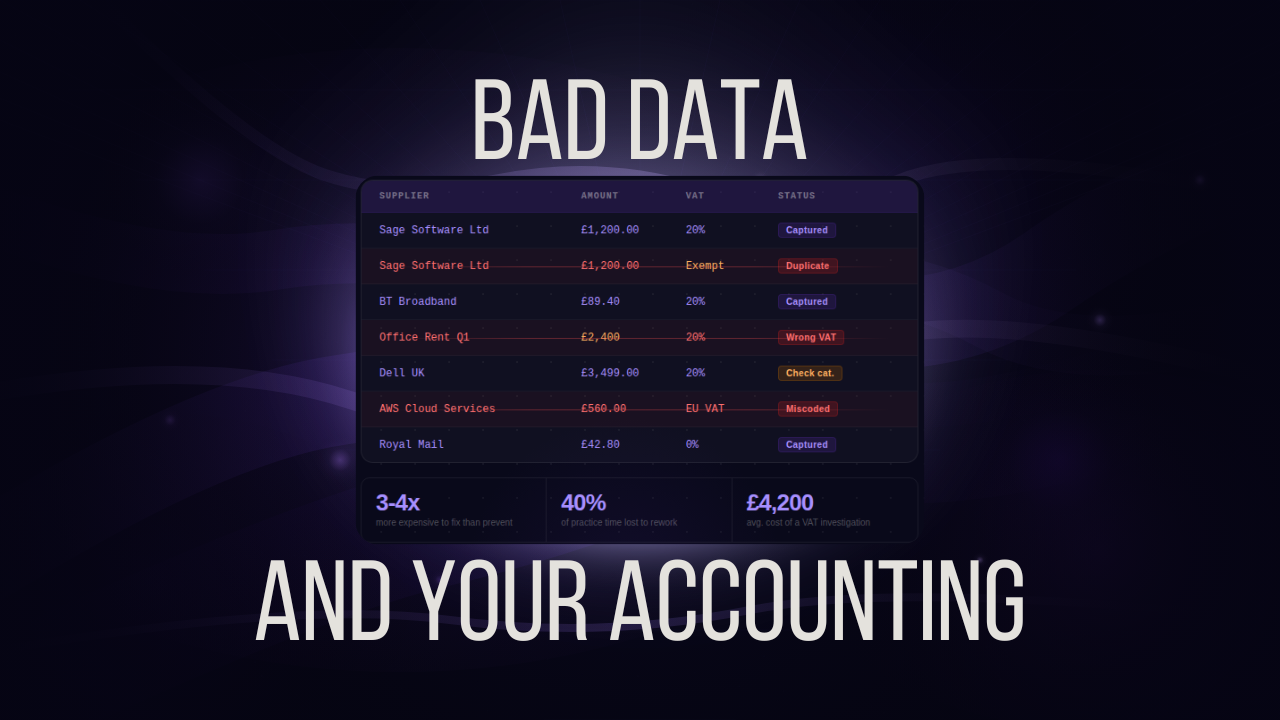
Ask any accountant what their biggest risk is, and most will say fraud, compliance, or a difficult client. Almost none will say bad data. Yet bad data – the wrong VAT code on a rent invoice, a duplicate supplier entry, a handwritten receipt keyed into the wrong category – is quietly one of the most expensive problems a practice can have. The reason it rarely gets named is the same reason it rarely gets fixed: it happens gradually, invisibly, and always at the speed of the next busy week.
This article is a practical guide. We will look at exactly where bad data enters accounting workflows, what it costs in real terms across different parts of a practice, and the concrete steps you can take to reduce it systematically. Whether you are a bookkeeper managing twenty client accounts, a practice owner running a team, or a business owner trying to make sense of your own numbers, the same principles apply.
"Bad data does not announce itself. It hides inside month-end reports and only surfaces when you can least afford to look."
Why Bad Data Is So Hard to See?
The defining characteristic of bad data is that it looks exactly like good data until it does not. A miscategorised invoice sits inside an Xero account alongside hundreds of correctly categorised ones. A duplicate payment clears a bank reconciliation because both amounts match real transactions. A VAT code applied by habit rather than by rule goes unchallenged until HMRC asks a question nobody expects.
This is the first and most important thing to understand: bad data is not mostly the result of carelessness. It is mostly the result of systems that require humans to make dozens of low-stakes decisions per hour, under time pressure, without feedback loops. The accountant who codes a rent invoice to 20% VAT instead of exempt is not being sloppy. They are working through a stack of forty invoices before a client call. The error is a system failure, not a people failure.
The HMRC risk is real. Under Making Tax Digital, digital records must be accurate and linked. A pattern of miscategorised VAT - even if totals are close - can trigger a compliance review. The cost of a VAT investigation far exceeds the cost of preventing the errors that caused it.
Understanding this reframes the solution. The answer is not to hire more careful people or add more review stages. It is to reduce the number of decisions a human has to make in the first place – and to ensure that the decisions that remain are made with the right information in front of them.
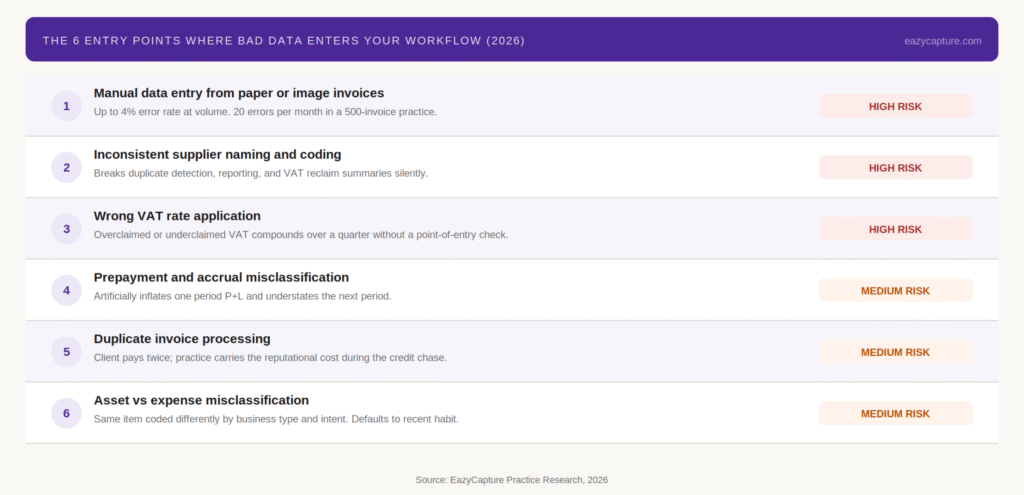
The Six Points Where Bad Data Enters Your Workflow
Bad data does not appear randomly. It concentrates on specific, predictable moments in the accounting workflow. Knowing where to look enables intervention before the error propagates downstream.
Putting a Number on It
The cost of bad data in accounting operates on two levels: the direct cost of fixing errors, and the indirect cost of the decisions made on the basis of wrong information. Most practices only ever see the first. The second is the more dangerous one.
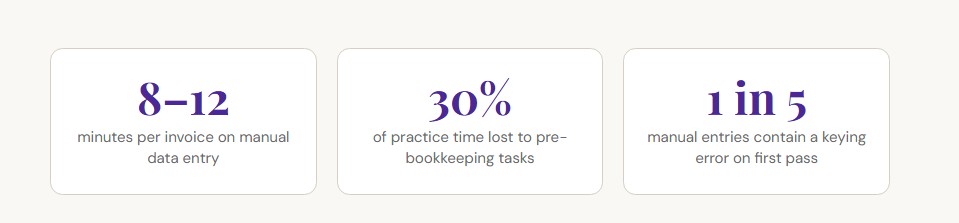
The indirect costs are harder to quantify but easier to recognise once you look for them. A client whose management accounts showed a profitable quarter – but only because annual costs were expensed in a single month – makes a hiring decision they cannot sustain. A business owner who sees healthy cash flow because a duplicate invoice has not yet cleared the bank holds off on a capital investment they actually needed to make. The numbers were wrong. The decisions were real.
"The most dangerous thing about bad data is that it is actionable. People make real decisions based on it - and they believe those decisions are informed."
How to Assess the Health of Your Data Right Now?
Before fixing anything, it helps to know where you stand. The scorecard below is based on the six entry points above. Score each area honestly – not based on what your process is supposed to do, but on what actually happens under normal load.’
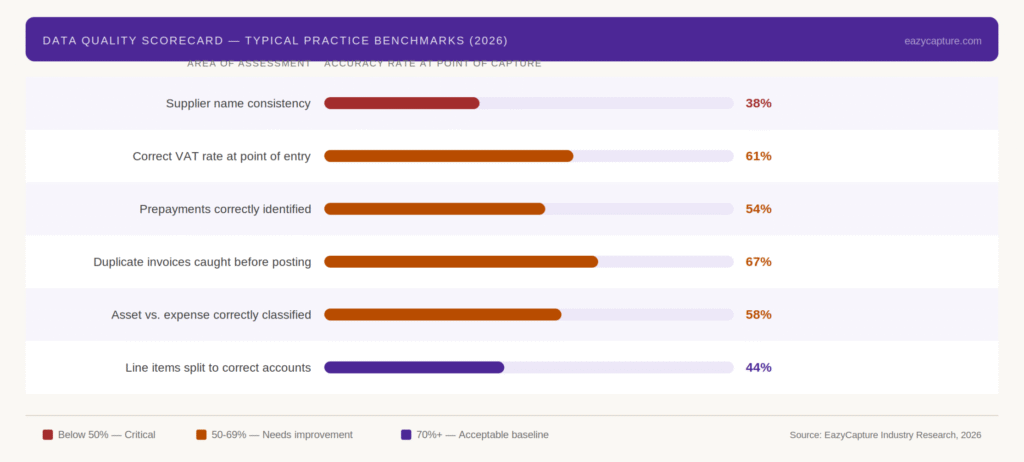
If you are reading these numbers and recognising your own practice, you are not alone – and you are not failing. These are industry-wide benchmarks from practices relying predominantly on manual workflows. The point is not to feel bad about them. The point is to understand that they are not inevitable.
A Step-by-Step Guide to Reducing Bad Data in Your Practice
The following steps are ordered by impact, not by ease. Some can be implemented this week. Others require a change in tooling. All of them compound – each step makes the next one more effective.
1. Move invoice capture upstream – before any human decision is made
The single highest-leverage change in any practice is to capture invoice data automatically, at the point of receipt, before anyone keys anything manually. This means using Intelligent Document Understanding Software that reads supplier names, amounts, dates, VAT rates, and line items directly from the document – whether it arrives as a PDF, a photo, a forwarded email, or a multi-page scan. The goal is to remove the data-entry layer entirely, not to make it faster.
Tip: EazyCapture does this automatically. Upload, forward an email, or snap a photo – key fields are extracted in minutes, with smart checks before anything reaches your accounting software.
2. Teach your system your chart of accounts – once
The most effective practices do not re-categorise invoices every time. They build a system that learns their categorisation rules and applies them consistently. Map your chart of accounts to supplier types and business profiles so that when a new invoice arrives from a known supplier category, the account code is pre-populated correctly rather than left to judgement. The system flags exceptions rather than guessing, so human attention goes where it is actually needed.
Tip: Set up your preferred account codes for common supplier types once. A good Intelligent Document Understanding tool applies them automatically going forward and queries only the genuinely ambiguous cases.
3. Implement VAT validation at the point of capture – not at month end
VAT errors are almost entirely preventable when the validation happens at the moment the invoice is processed. This means checking the VAT rate against the supplier type, the business context, and HMRC’s MTD requirements automatically, as part of the capture workflow. A VAT error caught before posting costs nothing. The same error caught after a quarterly return has been filed costs significantly more.
Tip: Look for software that is VAT-smart from day one – detecting 0%, exempt, 5%, 20%, EU VAT, and CIS implications at the point of capture, not as an afterthought.
4. Standardise your supplier naming convention and enforce it automatically
Supplier name inconsistency is one of the easiest problems to fix and one of the most consistently ignored ones. Maintain a canonical supplier list in your accounting software, and ensure that any new invoice capture routes to the canonical name – not the name on the invoice header, which varies by document. Intelligent Document Understanding tools that learn supplier aliases and normalise them to a single name eliminate this problem without any ongoing human effort.
Tip: Run a supplier report in Xero or QuickBooks and look for the same supplier appearing under two or more names. If you find more than three instances, your current process is not enforcing naming consistency.
5. Build a duplicate detection rule into every invoice intake workflow
Duplicate invoices are not a data entry problem – they are an intake problem. The solution is to check for duplicates before an invoice enters the workflow, not after it has been posted. The check should run against invoice number, supplier, amount, and date and it should happen automatically, every time, regardless of how the invoice arrived. A human reviewing for duplicates at month end is an expensive and unreliable backstop.
Tip: Does your current tool detect duplicates across different file formats? A PDF and a forwarded email of the same invoice should trigger one alert, not create two entries.
6. Review your data quality monthly with a short, structured check
The final step is the one most practices skip: a short, structured monthly data quality review before the management accounts are produced. Fifteen minutes on the last working day of the month, reviewing supplier consistency, VAT summaries by rate, and any flagged queries. The point is not to catch every error – the upstream steps should have prevented most of them. The point is to create a feedback loop so that any systematic patterns are visible before they compound.
Tip: A good dashboard shows you: flagged queries, unusual VAT distributions, new supplier names that do not match your canonical list, and any prepayments detected but not yet confirmed.
What Changes When Your Data Is Clean?
The difference between a practice running on bad data and one running on clean data is not visible in the accounts themselves. It is visible in everything around them. Here is what actually changes.
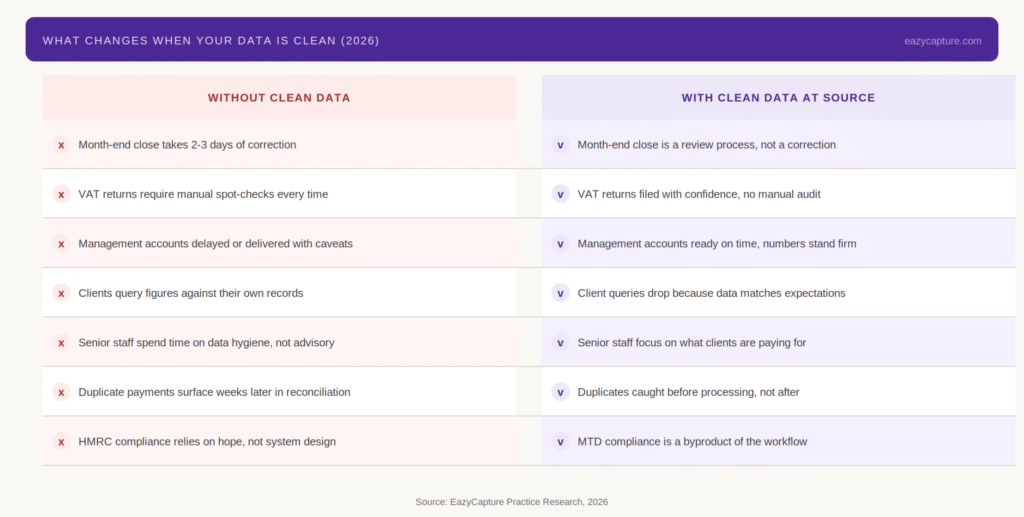
Every practical recommendation in this article rests on the same idea: data quality problems are infrastructure problems, and they have infrastructure solutions. Asking people to be more careful is not an infrastructure solution. Building a system that removes the conditions for common errors – and flags the uncommon ones before they propagate – is.
The practices that are running most effectively in 2026 are not the ones with the most diligent teams. They are the ones who have stopped asking their teams to make hundreds of low-stakes categorisation decisions per week. They have moved those decisions upstream – to Intelligent Document Understanding Software that can make them reliably, consistently, and at any volume – and freed their people to focus on the judgement that cannot be automated: advising clients, interpreting results, and building a practice worth trusting.
Bad data has a cost. So does fixing it. The only bill that does not arrive is the one you prevent from being issued in the first place.
Stop data errors before they enter your accounts.
EazyCapture captures supplier names, amounts, VAT rates, line items, prepayments, and duplicates automatically – and posts directly to Xero or QuickBooks with the original document attached. MTD-compliant from day one.