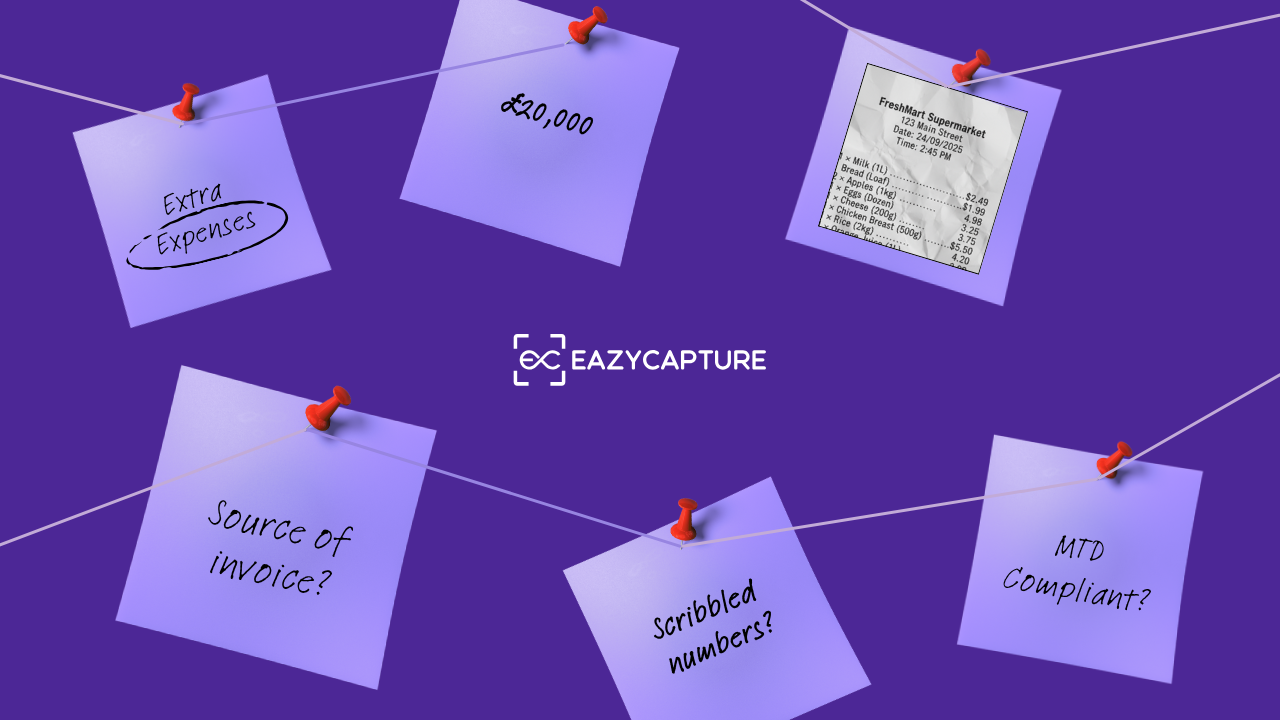
There is something deeply comforting about the phrase “we’ll deal with it at month-end.” It feels responsible, even strategic. After all, the invoice is sitting right there in the inbox. The VAT code can wait. The multi-page PDF will get processed once things quieten down. The problem isn’t the intention – it’s that “later” has a habit of arriving all at once.
The accounting profession runs on optimism. It has to. Every tax deadline navigated, every audit survived, every client rescued from their own bookkeeping chaos is a small victory against entropy. But there is a version of optimism that shades into something else – the quiet belief that the friction you feel every day is just the cost of doing business. That the manual work is manageable. That the bottleneck will somehow resolve itself.
It won’t. And deep down, most practice owners already know this.
"Optimism that ignores evidence isn't hope - it's a strategy for staying still."
The Invisible Tax on Your Practice
Manual invoice processing is one of the most expensive invisible costs in accounting. Not in the way a bad software subscription is expensive – you can see that on a bank statement. The cost here is dispersed across hundreds of small moments: the three minutes re-keying a supplier invoice, the duplicate entry caught (or not caught) before posting, the VAT code applied by instinct rather than certainty, the client query that could have been auto-generated but wasn’t.
Individually, these moments feel trivial. Collectively, they consume something that cannot be bought back: time that could have been spent on advisory work, on growing the client base, or simply on leaving the office at a reasonable hour.
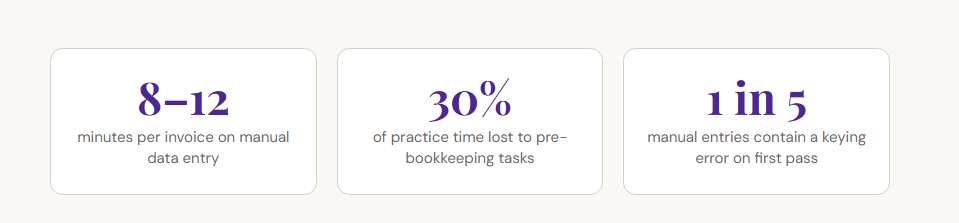
These numbers aren’t meant to alarm. They’re meant to name something that already exists in the background of every practice, quietly draining the capacity that the optimist in the room has simply learned to absorb.
Optimism vs. Denial: Knowing the Difference
It is worth being precise about this, because the distinction matters professionally and personally. Optimism is an asset. The conviction that things can be improved, that clients can be served better, that the practice can grow – this is the engine of every successful firm. Denial is something different. Denial is what happens when optimism is used as a reason not to look at the evidence.
Here is a simple diagnostic. Which column sounds more like your practice?
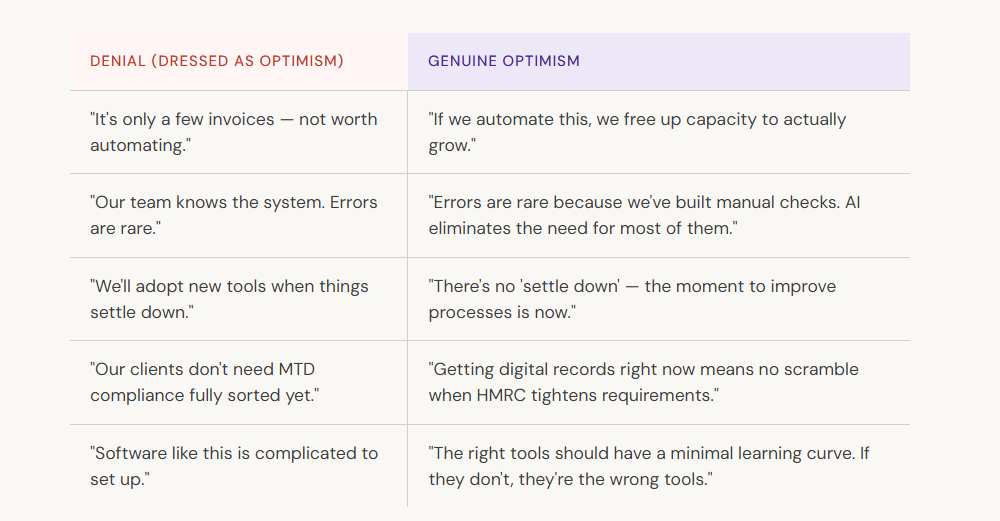
Neither column is a moral judgement. Most practices live somewhere across both. The point is to notice which framing is driving your decisions about growth, capacity, and technology.
What Actually Changes When You Stop Managing and Start Capturing?
The shift from manual invoice management to intelligent, automated capture is less dramatic in practice than it sounds in a product brochure. It isn’t a revolution. It’s more like the feeling of clearing your desk and realising how much easier it is to think.
When software understands the context of your practice – your chart of accounts, your clients’ business types, your VAT rules, your CIS obligations – it stops being a tool you use and starts being infrastructure you rely on. The difference is felt in the small things first:
- A multi-page PDF arrives, and each invoice inside it is treated as a separate, complete record – no manual separation needed.
- A software subscription invoice is automatically flagged as a prepayment, not expensed in full to the wrong period.
- An invoice arrives in French. It’s processed, translated, and posted correctly – no manual intervention.
- A handwritten “Paid” note on a supplier invoice is recognised. The reconciliation note is there before you’ve even opened Xero.
- Five invoices photographed on a desk are treated as five distinct records, not one blurry image to untangle.
None of these is a headline feature. They’re the unglamorous, daily, compounding work of a practice that runs cleanly. And they’re exactly the kind of work that optimism alone can’t sustain indefinitely.
"The practices that grow aren't the ones that work harder. They're the ones that stopped treating infrastructure as a luxury."
A Note on Timing
One of the most persistent forms of accounting optimism is the belief that technology adoption can be scheduled around busyness. January through April is too hectic. Summer is quieter, but somehow the moment never quite arrives. Autumn brings a new wave of year-ends. The calendar, it turns out, is always full.
The practices that have moved forward – the ones using AI capture, posting directly to Xero and QuickBooks, maintaining clean digital records ahead of MTD requirements – didn’t find a window. They decided the window was a fiction and started anyway.
The interesting thing about tools built with accountants, tested by accountants, and shaped by practitioners with decades of real-world experience: the learning curve isn’t the obstacle it once was. The friction of adoption has been engineered out. What remains is just the decision.
A Question Worth Asking
If you looked at your practice honestly – not defensively, but with the same clear eye you bring to a client’s books – what would you find? Hours spent on work that shouldn’t require human attention? Processes held together by habit rather than design? Capacity that’s “fine” but not freed?
Optimism says, “This can be better”.
Denial says, “It’s already fine. The practices thriving right now are the ones that listened to the first voice.”