
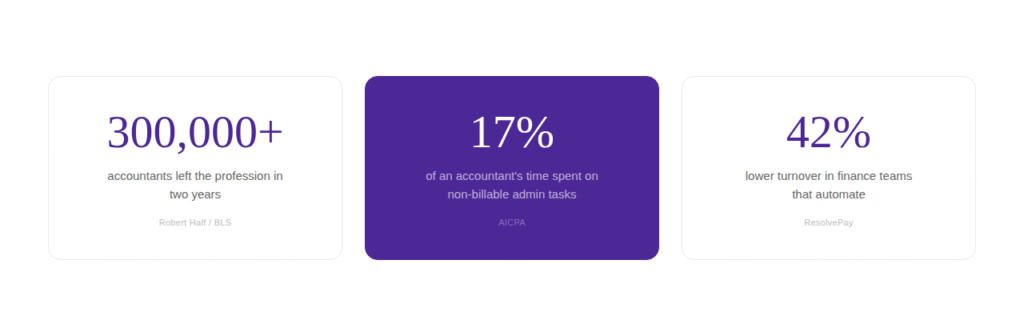
The accounting profession has a talent crisis. That much is settled. Over 300,000 U.S. accountants and auditors left their jobs in two years. CPA exam participation has fallen 27% in a decade. Robert Half reports that 90% of finance leaders struggle to find qualified hires, and Fortune found that half say it takes 60+ days to fill a single role.
Firms are turning down work. Salaries are climbing. The pipeline is shrinking faster than retirements can explain.
But the talent shortage, real as it is, has become a convenient explanation for a deeper problem. When you look at where hours actually go inside these firms, the bottleneck isn’t headcount. It’s how the existing headcount spends its time.
The 17% Problem
The AICPA reports that roughly 17% of an accountant’s time goes to non-billable administrative work. Re-keying invoices. Chasing receipts. Manually categorising expenses. Correcting entries. Reconciling records that don’t match because someone typed £1,430 instead of £1,340.
For a ten-person firm billing at £80 per hour, that 17% represents approximately £212,000 per year in unrealised revenue. Not a rounding error. A salary. Possibly two.
Manual data entry error rates run between 1% and 4%. At volume, that translates to hundreds of corrections per firm per year. Each correction costs time, delays reporting, and compounds when staff are already stretched thin.
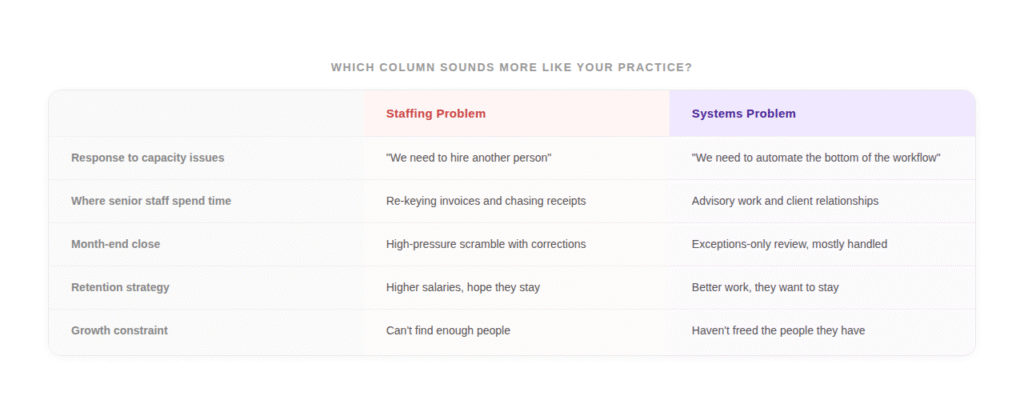
Fewer people. More work. A growing share of capacity consumed by tasks that shouldn’t require human attention. That’s not a staffing problem. That’s a workflow problem wearing a staffing mask.
Why People Actually Leave?
Turnover in public accounting runs between 15% and 22% annually, with 84% of departures voluntary. Rightworks’ 2025 Post-Tax Season Survey found that 12% of firms scaled back their client base simply to match available workforce.
The pattern in exit data is consistent: long hours, repetitive tasks, limited growth. Nobody leaves because advisory work was too demanding. They leave because too much of the day was spent on data entry that added no value to the client or the firm.
Every hour a qualified accountant spends processing receipts is an hour not spent on advisory, client relationships, or the kind of work that retains talent and grows revenue. The profession isn’t losing people because the work is too hard. It’s losing them because too much of the work is too low-value.
“The profession isn’t losing people because the work is too hard. It’s losing them because too much of the work is too low-value.”
300 Hours
A practice processing 500 invoices per month at 3 minutes each spends 25 hours monthly on data entry. Over a year: 300 hours. At £80/hour, that’s £24,000 in billable value consumed by manual processing. Before corrections. Before duplicates. Before time spent chasing clients for missing documentation.
EazyCapture eliminates that loop. Invoices are captured immediately: supplier, date, amount, VAT, line items extracted in seconds and mapped to the chart of accounts. Prepayments are flagged. CIS is handled. Multi-page PDFs are separated. Handwritten notes are recognised. Five receipts photographed on a desk are treated as five distinct records. Automated accuracy rates sit between 99.959% and 99.99%.
The team doesn’t disappear. It moves up the value chain. From processing to advising. From entering data to interpreting it.
The Hire That Isn’t Needed
Organisations that automate reconciliation report 65% more time on strategic work and 42% lower turnover in finance departments. The second number matters most. People stay when the work improves.
Hiring is expensive. Training is slow. Retention is fragile. Reclaiming 300 hours from a system that costs a fraction of a salary is immediate, measurable, and compounds every month.
The firms that will thrive through this talent crisis are not the ones outbidding everyone for the same shrinking pool. They are the ones that stopped asking “who else can we hire?” and started asking “what else can we automate?”
Start with a trial of EazyCapture.