
Here’s a question: How much does a single lost receipt actually cost a business?
Not in theory. Not in some abstract “good practice” sense. In real, measurable pounds and dollars.
So we researched… and figured out that the cost of a single lost receipt is almost nothing.
But the cost of the pattern of losing receipts is enormous. And almost nobody is tracking it.
What the GBTA Data Actually Says
The GBTA Foundation, in partnership with HRS, published one of the most comprehensive studies on expense reporting ever conducted. We keep coming back to three numbers from it:
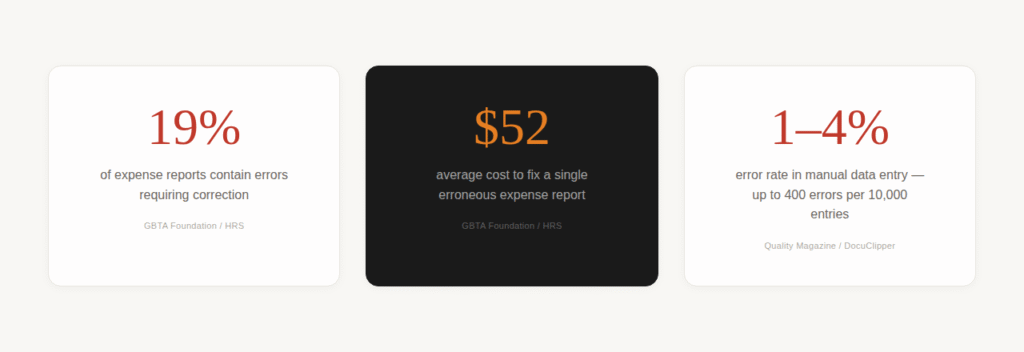
- 19% of all expense reports contain errors.
- Each error costs an average of $52 to correct and takes 18 minutes to resolve.
- Across a year, the average company wastes roughly $500,000 and 3,000 hours on corrections alone.
Read that again. Half a million dollars. Three thousand hours. And those are averages across companies that already have reporting systems in place.
The firms without structured processes? They’re not even in the dataset. Their losses are invisible because nobody’s counting.
The study also broke down where the pain actually lives. Among companies processing reports internally without third-party software:
- 55% said attaching receipts was a major problem.
- 54% cited data entry as a significant pain point.
- 49% struggled with simply setting up the expense report.
So the entire front end of expense documentation (the part that matters most for accuracy) is where things collapse first.
The 1% Error Rate That Isn’t 1%
Here’s where it gets interesting.
You’ll see a statistic cited everywhere in data management: the average error rate in manual data entry is about 1%. One mistake per hundred entries. Sounds manageable, right?
But no. Research published in Quality Magazine tells a much more important story.
In a typical workflow, data gets entered twice. Once in the field (on paper or a phone) and then again when it’s transferred into the system. Two touchpoints. Two chances for error per record. When you do the maths on that, a 1% per-entry error rate compounds to produce mistakes in up to 40% of all records.
Nearly half your records could contain a data entry error.
For context, automated data entry systems achieve accuracy rates between 99.959% and 99.99%. For every 10,000 entries, a machine makes between 1 and 4 mistakes. A human makes between 100 and 400.
That’s not a marginal improvement. That’s a completely different category of reliability. And in a small business processing invoices and receipts week after week, it translates directly into:
- Amounts keyed incorrectly.
- VAT codes applied by instinct rather than verification.
- Expenses posted to the wrong nominal code.
- Duplicates created because the original was entered slightly differently.
Each one of these is a small distortion in your books. Together, they’re a pattern of drift that only becomes visible at the worst possible time: during an audit.
The Deduction You Didn’t Know You Lost
This is the part that connects the filing problem to the financial one.
HMRC and the IRS are both unambiguous on this point: the burden of proof sits with the taxpayer. You claim a deduction, you prove it. Receipts, invoices, bank statements, or equivalent records showing the amount, date, place, and business purpose of each expense.
When documentation is missing, the deduction doesn’t just become uncertain. It becomes indefensible.
During an audit (and HMRC can enquire into returns going back several years), the question isn’t whether the expense happened. The question is whether you can prove it did. A missing receipt for a legitimate £300 business expense doesn’t mean you spent the money fraudulently. It means you can’t claim the tax relief you were entitled to.
Multiply that across a year of undocumented lunches, mileage, supplies, subscriptions, and minor purchases, and the figure becomes material. For many small businesses, poor documentation doesn’t just increase audit risk. It quietly inflates the tax bill by thousands of pounds annually.
And here’s the cruel irony. The businesses most likely to miss deductions are the ones working hardest. The sole trader too busy delivering the service to photograph the receipt. The practice owner who planned to reconcile last month’s expenses but got pulled into client work. Busyness and disorganisation aren’t the same thing. But the financial outcome is identical.
“The businesses most likely to miss deductions are the ones working hardest. Busyness and disorganisation aren’t the same thing. But the financial outcome is identical.”
The Month-End Myth
“We’ll sort it at month-end.”
This is possibly the most expensive sentence in accounting. Not because it’s wrong in principle. But because of what actually happens between now and month-end.
- Memory degrades. The business purpose of a £65 transaction gets harder to recall as days pass. Was it a client dinner or a team lunch? The category matters for tax treatment.
- Duplicates multiply. Without real-time capture, the same expense can get entered from a bank feed and then again from a late-arriving receipt. Now you’ve got a reconciliation problem.
- Error rates climb. Research consistently shows that the further removed data entry is from the original transaction, the higher the error rate. Delayed processing isn’t just slower. It’s less accurate.
- Advisory time disappears. Every hour spent untangling deferred receipts is an hour not spent on advisory work, client relationships, or practice growth.
Month-end feels organised. In practice, it means compressing weeks of accumulated friction into a few days of high-pressure reconciliation. Exactly the conditions under which errors are most likely to occur.
What Changes When You Capture at the Point of Transaction?
The fix isn’t dramatic. It’s not a full software migration or a six-month digital transformation project. It’s more like the difference between filing as you go and filing from a pile.
This is what we built EazyCapture to do.
When an invoice arrives (PDF, email forward, or a photo of a paper receipt) EazyCapture extracts the data immediately: supplier, date, amount, VAT rate, line items. It maps to your chart of accounts. It identifies prepayments, flags assets by business type, and handles CIS deductions. No manual intervention.
Here’s what that looks like in practice:
- A multi-page PDF containing twelve invoices is separated and processed individually. No manual splitting.
- Five receipts photographed on a desk are treated as five distinct records, each extracted and categorised independently.
- A handwritten “Paid” note on a supplier invoice is recognised and factored into reconciliation.
- An invoice in French or Arabic is captured, translated where needed, and posted correctly.
- A software subscription is automatically flagged as a prepayment. Not expensed in full to the wrong period.
None of these is a headline feature. They’re the unglamorous, compounding work of a practice that runs cleanly. And they’re exactly the kind of tasks that fall through the cracks when processing is deferred, manual, or dependent on someone remembering to do them.
So What’s the Real Cost?
“It’s just a receipt” is never about one receipt. It’s a pattern. A system-level tolerance for information loss that compounds quietly over weeks, months, and financial years.
The GBTA data gives us the correction cost. The data entry research gives us the error rate. Tax law gives us the documentation burden. And every practice owner already knows, even if they haven’t quantified it, the hours absorbed by work that shouldn’t require human attention.
The question isn’t whether this matters. It’s how long you can absorb the cost before it becomes the thing holding back growth.
A Question Worth Asking
If you looked at your practice with the same clear eye you bring to a client’s books, what would you find?
Receipts logged from memory rather than documentation? Expenses categorised by instinct rather than verification? Capacity that’s “fine” but never quite freed?
The practices that scale aren’t the ones that work harder. They’re the ones who stopped treating capture as something that can wait.
Start with a trial of EazyCapture.