Business owners across the United Kingdom and beyond face a similar challenge. Aside from dealing with a stack of invoices, they do not have time for analyzing data to understand their financials.
Many of the top-rated and preferred AI accounting software, such as EazyCapture, have been developed to address this issue.
However, not every accounting tool labeled “AI-powered” actually delivers on its promises. Many platforms just rebrand basic automation as artificial intelligence.
So, how do you choose the best AI accountant tool?
Introduction
In actuality, effective AI accounting software should learn from your data patterns. It should understand your business structure.
This year, the global market for Artificial intelligence in accounting is expected to reach £5.21 billion, with projections showing strong growth to £29.33 billion by 2030.
We will move beyond the marketing claims and uncover the AI-based software that gives real results to support your business better.
What Makes Accounting Software a Long-Term Asset for Your Business Operations?
Before discussing any particular software, we will clarify what “delivering results” means for AI accounting tools.
An effective AI invoicing tool should significantly streamline key accounting workflows.
The most important areas where AI is applied in accounting include:
- Scan bills, invoices, and receipts to automatically capture essential data, such as vendor information, dates, amounts, and taxes, using optical character recognition (OCR).
- The software should categorise transactions, for example, by assigning accounts or tax codes, using machine learning.
- Manual bank reconciliation takes hours each week. Your software should connect directly with your business accounts and automatically match transactions with invoices and bills.
- Reviewing expense claims or purchase invoices for duplicates, policy violations, or VAT errors can be tedious. An AI tool can check totals and help find missing receipts. Your software should have HMRC Making Tax Digital (MTD) capabilities instead of depending on workarounds or third-party integrations.
- AI features in accounting software can spot patterns and provide forecasts or insights. For example, it might predict cash flow problems or point out account discrepancies that need further attention. While basic bookkeeping is essential, some apps also offer advisory insights and support for decision-making.
Also Read: Why AI-Driven Validation is the Next Billable Service for Accountants?
Why AI Tools Matter for UK Accountants?
The shift toward automation is not just a trend.
It’s driven by real pressures in the UK market:
1. Increasing transaction volumes
Even small UK practices now process hundreds of financial documents every month. As clients digitise operations, invoices come from multiple channels – email, apps, marketplaces, POS systems – making it harder to keep consistent, accurate records. AI solves this by automatically reading, interpreting and categorising financial data.
2. Compliance and Making Tax Digital (MTD)
With MTD requirements expanding, businesses need cleaner digital records, faster submissions and fewer errors. AI reduces the manual mistakes that traditionally cause VAT discrepancies and filing delays.
3. Shift towards advisory services
Accounting firms that automate low-value admin work gain more capacity to offer high-margin services like forecasting, coaching, budgeting, and CFO-style insights. AI is the enabler of that shift.
4. Rising client expectations
Clients expect real-time insights and faster responses. AI-powered categorisation, reconciliation, and dashboards help accountants deliver that without increasing staff workload.
What to Look for in an AI Accounting Tool?
Before comparing the tools, UK accountants should evaluate these criteria:
- Data capture accuracy: Can it read multi-page PDFs? Handwritten invoices? Low-quality scans?
- Automation depth: Does it only extract data, or does it also post, reconcile, detect errors, or predict patterns?
- UK compliance readiness: VAT, MTD, CIS, payroll compatibility.
- Integration quality: Does it sync smoothly with systems like Xero, QuickBooks, Sage or Zoho?
- Ease of onboarding: Can non-technical staff adopt it quickly?
- Scalability: Suitable for multiple clients, multi-entity setups, or high document volumes?
- Value for money: Does the automation genuinely save hours per month?
With this framework in mind, let’s break down the major tools.
1. EazyCapture
EazyCapture is built specifically to solve the biggest time drain in UK bookkeeping – manual document handling.
Instead of sifting through piles of receipts, scanning invoices, or keying numbers into spreadsheets, accountants can upload bulk documents, and EazyCapture’s AI extracts, cleans, and posts the data directly to the accounting system.
Its strength lies in its “pre-bookkeeping assistant” positioning.
It’s laser-focused on automation of the front-end tasks like invoice capture, categorisation patterns, multi-page PDF extraction, and even handwritten text recognition. Because the tool is built with real UK accounting workflows in mind, it understands the document inconsistencies accountants battle with daily.
EazyCapture isn’t a full accounting suite, but that’s precisely its value – it integrates seamlessly with the systems you already use.
For firms wanting to reduce staff hours spent on admin and allocate more resources to reconciliation and advisory, EazyCapture provides a major time-saving advantage.
Features
- AI-powered invoice and receipt capture
- Bulk upload of multi-page PDFs
- Handwritten text recognition
- Automated data extraction & posting
- Learns categorisation patterns over time
- Designed specifically for UK workflows (VAT, MTD-compatible)
- Integrates with major accounting platforms (Xero, QuickBooks, Sage)
Pros
- Exceptional for heavy document volumes
- High data accuracy compared to generic OCR tools
- Reduces manual admin hours significantly
- Built for UK accountants’ real-world document issues
- Smooth integration into existing accounting systems
2. QuickBooks (UK)
QuickBooks remains one of the most widely adopted platforms among UK SMEs. Its strength comes from its user-friendly interface, cloud accessibility, and strong built-in AI for everyday bookkeeping tasks.
Features such as automated expense categorisation, receipt capture via mobile, and smart cash-flow predictions make it ideal for small businesses and accountants managing fast-moving client portfolios.
For UK compliance, QuickBooks supports MTD for VAT, payroll integration, and real-time reporting.
It’s reliable and familiar, which is why many firms include it as their base accounting system. However, firms with heavy volumes or complex, multi-entity structures may eventually outgrow their simplicity.
Features
- AI-powered expense categorisation
- Mobile receipt capture
- Cashflow forecasting and predictions
- Automated bank feed imports
- MTD-compatible VAT filing
- Payroll integration
- Real-time dashboards and reports
- Large app ecosystem
Pros
- Very easy for clients and SMEs to use
- Wide market adoption in the UK
- Strong mobile features
- Reliable automation for common bookkeeping tasks
- Integrates with hundreds of apps
Cons
- May not scale well for complex/multi-entity firms
- Advanced automation features can require higher-price plans
- AI isn’t specialised for messy or high-volume document workflows
- Limited deep customisation for accountants
3. Xero
Xero is another powerhouse in the UK market, especially popular with digital-first accountants and modern practices. It offers clean dashboards, excellent bank feed automation, strong reconciliation capabilities, and a massive integration ecosystem. Xero’s AI assists in predicting transaction categories, identifying anomalies, and learning from previous patterns.
For accountants managing multiple clients, Xero’s platform is intuitive and time-efficient.
It strikes the right balance between automation and control, although AI-heavy features are still developing compared to specialist tools.
Features
- Automated bank feeds and reconciliation
- AI-driven categorisation suggestions
- Smart anomaly detection
- Customisable dashboards & financial reports
- MTD-ready VAT filing
- Thousands of app integrations
- Multi-client accountant portal
- Easy collaboration tools
Pros
- Very strong for UK accountants with multiple clients
- Clean, modern UI with simple workflows
- Large integration marketplace
- Great for small and medium-sized businesses
- Reliable automation for matching & categorising transactions
Cons
- AI is not as advanced as specialist automation tools
- Lower-tier plans have feature limitations
- High-volume or complex enterprises may find it restrictive
- Some features rely heavily on third-party apps
4. Zoho Books
Zoho Books is known for affordability and flexibility. It integrates seamlessly with the broader Zoho suite – CRM, Projects, Inventory – which is attractive for small UK businesses seeking an all-in-one ecosystem.
Its AI assistant, Zia, automates categorisation, anomaly detection, and receipt processing, making it useful for smaller firms wanting AI without premium pricing.
However, it may not meet the depth required by larger UK accounting practices, especially those handling complex structures or multiple entities.
Features
- AI assistant (Zia) for automation & anomaly detection
- Receipt scanning and data extraction
- Invoicing, inventory, and project tracking
- Automated categorisation rules
- UK VAT support
- Strong integration with the Zoho ecosystem
- Workflow automation builder
- Client and vendor portals
Pros
- Extremely cost-effective
- Excellent for startups and early-stage SMEs
- Strong automation for the price
- All-in-one ecosystem boosts efficiency
- Easy to customise workflows
Cons
- Not ideal for complex, multi-entity UK firms
- AI is helpful, but not as advanced as premium tools
- Ecosystem lock-in if you rely on multiple Zoho apps
- Limited depth in advanced accounting functions
5. Dext
Dext (formerly Dext Prepare / Receipt Bank) is one of the most established data-capture tools used by accountants globally.
It specialises in extracting data from invoices, receipts, bank statements, and supplier documents. Dext is well-known for its reliability, strong ecosystem of integrations, and long-standing presence in the UK bookkeeping market.
However, unlike more modern AI-led tools, its data extraction often relies on template-based logic rather than deep-learning pattern recognition. While Dext is powerful and mature, some practices find the experience less flexible when dealing with messy uploads, multi-page PDFs, or poorly formatted documents – areas where newer tools often excel.
Features
- Receipt and invoice extraction
- Automated expense categorisation
- Bank statement extraction
- Integrations with Xero, QuickBooks, Sage
- Supplier rule automation
- Mobile receipt capture
- Approval workflows
Pros
- Reliable and trusted among UK bookkeepers
- Strong mobile app and user-friendly interface
- Wide integration support
- Good for multi-client accounting firms
Cons
- Less advanced handwritten text handling
- Multi-page or mixed-document PDFs sometimes require manual checks
- AI improvements are slower compared to newer entrants
- Pricing increases over the years have pushed some firms to alternatives
Read Also: 3 Lucrative Niche Markets Your Firm Can Dominate Using Smart Capturing Tools
A Quick Comparison: Why EazyCapture Stands Out?
In a UK accounting environment where speed, accuracy, and cost-efficiency matter more than ever, EazyCapture positions itself to solve the most painful part of the workflow: document preparation and pre-bookkeeping data intake.
While Xero, QuickBooks, Zoho, and Dext all automate parts of the accounting cycle, EazyCapture specialises in the front-end — the stage where most firms lose hours every week.
Many UK practices report that 70–80% of bookkeeping time is wasted before transactions even reach the ledger. This includes:
- chasing documents
- renaming files
- splitting PDFs
- data entry
- correcting errors
- formatting batches
EazyCapture’s technology directly attacks this bottleneck.
Tool | Best For | Strengths | Limitations | Why EazyCapture Leads |
EazyCapture | UK accounting firms with high document volume | Best-in-class document capture, handwritten recognition, multi-page PDF extraction, UK-focused workflows, seamless posting automation | Requires pairing with a ledger system | Most accurate capture + tailored to UK bookkeeping → biggest time savings |
QuickBooks (UK) | SMEs & accountants on familiar systems | Strong automation, mobile app, MTD-ready VAT, wide ecosystem | Scaling issues for multi-entity firms | Great ledger tool, but weaker at deep capture workflows |
Xero | Digital-first UK firms | Clean UI, great reconciliation, AI suggestions, huge integrations | AI still developing; relies on apps for advanced tasks | Works perfectly with EazyCapture as the intake layer |
Zoho Books | Startups and small businesses | Cost-effective, strong automation for the price, Zia AI | Lacks depth for large or complex firms | Best value, but not built for multi-client practices |
Dext | Traditional bookkeeping firms | Trusted extraction tool, strong vendor rules | Struggles with messy uploads, handwritten docs, multipage PDFs | Older extraction logic → less accuracy vs EazyCapture’s modern AI |
Start Using EazyCapture In Your Bookkeeping And Accounting Practice
The accounting profession is undergoing a quiet revolution. Tasks that used to eat up days of a bookkeeper’s time are now being handled in seconds by well-trained algorithms.
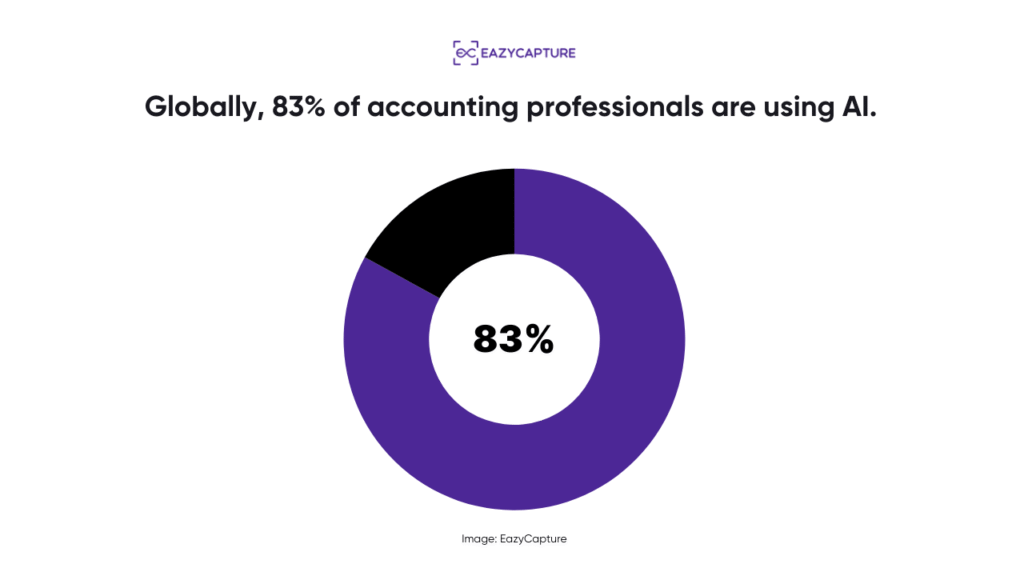
Artificial intelligence in accounting has moved beyond experimental technology into essential infrastructure. Globally, 83% of accounting professionals are using AI.
The accounting tools we reviewed provide some benefits. Nonetheless, the option that excels in fully automating bookkeeping is EazyCapture.
EazyCapture eliminates the risk of trying new software with its thirty-day free trial.
You can test every feature, process real invoices, and experience the platform’s intelligence before making any financial commitment.
Bring EazyCapture into your practice today!